【Carbon Exploration of Energy Storage】From MWh to GWh: JDEnergy Delivers a “String-Based Solution” at the Dengkou Energy Storage Project in Inner Mongolia

In August 2026, a 500MW/2000MWh energy storage power station in Dongkou, Inner Mongolia, became a major focus of attention in the industry.
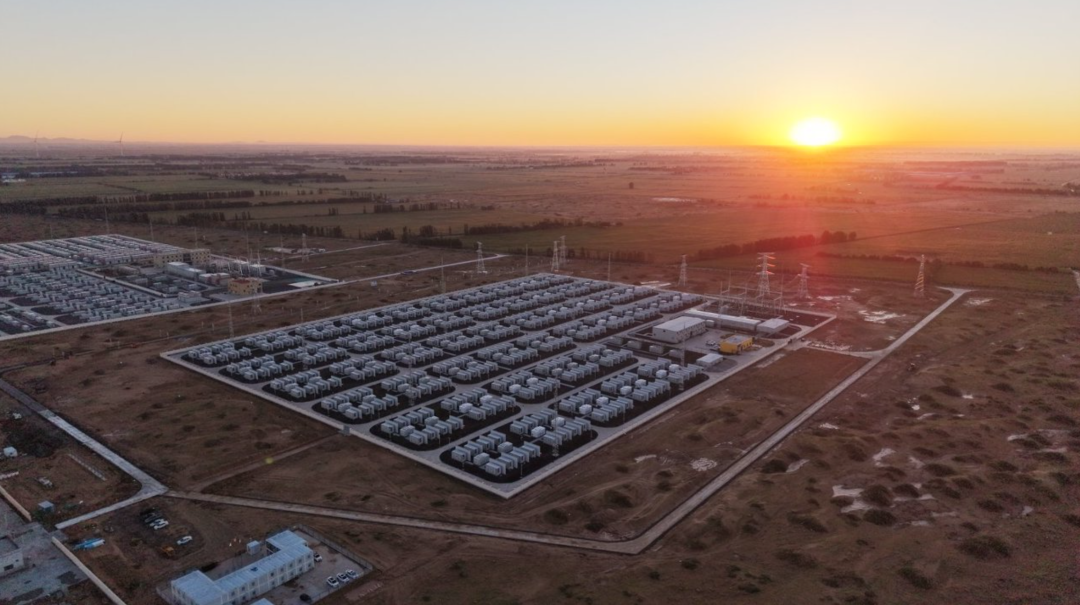
Driving north from Wuhai city for more than an hour, one enters Dongkou County. At the boundary between the desert and farmland, 400 gray-white energy storage prefabricated cabins are neatly arranged in a modular layout. Every four cabins form a group, connected to the grid through one integrated collector and step-up unit. A 220kV booster station stands nearby, connected to the Xiangtai Substation through a single transmission line.
This is the first GWh-level project delivered by JDEnergy, and it also marks the first large-scale application of JDEnergy’s string-based prefabricated cabin Galaxy-1 in a source-grid-side independent energy storage scenario.
What has truly drawn industry attention is a set of figures: the project completed delivery of all equipment within just 60 days, and completed full-station commissioning and “three charge-three discharge” verification within only 7 days. Against the backdrop that GWh-level projects typically require 6–9 months for delivery, this represents a remarkable achievement.
More importantly, the Dongkou project has been operating stably for more than half a year. As of the end of June 2026, the project had accumulated 405,800 MWh of charging capacity and 359,200 MWh of discharging capacity, achieving an overall conversion efficiency of over 88.5%, 100% system availability, and maintaining a top-10 regional ranking in revenue performance.
With curiosity, the reporter stepped into this energy storage power station built above the desert.
A “Lightning-Speed Delivery Battle”
The Dongkou project deployed 400 Galaxy-1-4G string-based prefabricated cabins and 100 eLink-HV35 integrated collector and step-up units. Viewed from above, the 400 prefabricated cabins stand like a neatly arranged formation, casting orderly shadows under the sunlight.
In Inner Mongolia, independent energy storage projects commonly face challenges such as tight construction schedules, low winter temperatures, strict fire safety requirements, and complex grid connection coordination. These conditions place extremely high demands on the entire project delivery chain. Completing all equipment delivery within 60 days meant that every stage—from production scheduling and logistics coordination to on-site installation—had to operate seamlessly.
According to the project engineer, the key to the Dongkou project was not simply “speed”, but “controllability”. JDEnergy’s string-based prefabricated cabin Galaxy-1 adopts an “All In One” design concept, integrating 314Ah lithium iron phosphate batteries, BMS, string-based PCS, fire protection systems, thermal management systems, power distribution, communication systems, and other components into a standard 20-foot container. The standardized design of the AC/DC integrated energy storage cabin ensures that every prefabricated cabin follows identical production processes, quality standards, and delivery specifications. Full-system performance verification can be completed before leaving the factory, making rapid delivery for large-scale projects possible.
Equipment delivery was only the beginning of the Dongkou project’s efficient execution. The greater challenge was how to complete commissioning, grid connection, and commercial operation of 400 devices within such a short period after arrival on site.
Traditional centralized energy storage projects usually require weeks or even months for commissioning. However, the Dongkou project completed full-station commissioning and “three charge-three discharge” verification in just 7 days. JDEnergy adopted a “front-loaded delivery” approach: single Galaxy-1 units completed factory testing and system integration before delivery, while on-site work was simplified into cabin lifting, rapid cable connections, and system commissioning—achieving efficiency similar to “assembling building blocks”.
This approach significantly reduced dependence on outdoor weather and environmental conditions, shortening the construction period by more than 40% compared with traditional methods and enabling rapid project deployment. Meanwhile, standardized factory production eliminated uncertainties caused by on-site construction, ensuring consistent quality and reliable workmanship for every prefabricated cabin. The enclosed cabin design also improves operational safety and effectively reduces risks such as fire and electric shock.
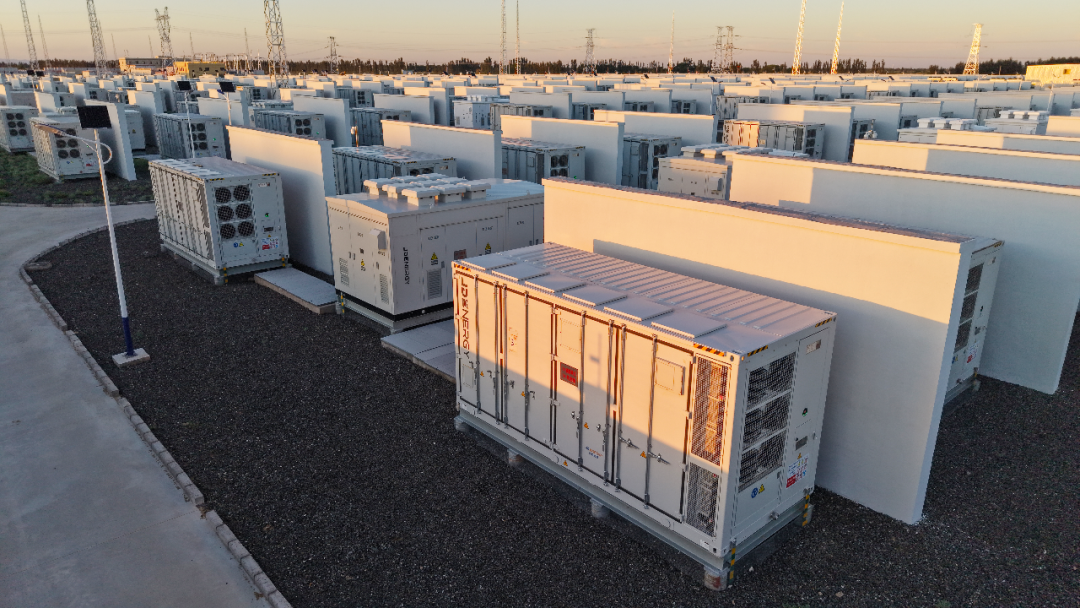
The reporter noticed a detail at the site: the arrangement, cable interfaces, and identification systems of all 400 Galaxy-1 prefabricated cabins were almost identical. This “building-block-style” engineering delivery model makes installation and commissioning of GWh-level projects more controllable and efficient.
88.5% Comprehensive Efficiency
According to 2025 energy storage power station operation data released by the China Electricity Council, the average comprehensive efficiency of grid-side energy storage stations was 82.21%, with a benchmark value of approximately 85%. However, the Dongkou project achieved a comprehensive conversion efficiency exceeding 88.5%—more than 6 percentage points higher than the industry average. For a 2000MWh-scale energy storage power station, what does a 6-percentage-point efficiency difference mean? It could translate into millions or even tens of millions of yuan in annual revenue differences. Behind this performance lies the advantage of JDEnergy’s system architecture and equipment capabilities.
Traditional centralized energy storage systems connect multiple battery clusters in parallel to a single high-power PCS. Small differences in cluster voltage and internal resistance can generate circulating currents within parallel circuits, causing some cells to experience excessive charging and discharging, accelerating aging. Meanwhile, some cells may fail to fully charge or discharge, leaving capacity unused. Under the “barrel effect”, the overall performance, lifespan, and safety of the energy storage system are reduced.
In contrast, the Dongkou project adopts a string-based architecture, where each battery cluster independently connects to a string-based PCS, achieving 100% charge and discharge depth. Combined with JDEnergy’s self-developed battery management system (BMS), precise full-time balancing strategies, cluster-level independent control topology, and efficient thermal management strategies, the system ensures that battery cells always operate within an optimal environment, reducing thermal losses. Meanwhile, vector control algorithms improve conversion efficiency, and optimized matching between PCS and battery string voltage reduces PCS losses by 30%. Ultimately, this enhances overall conversion efficiency and delivers greater economic value for owners and investors.
It is worth noting that since the Dongkou project entered commercial operation in January 2026, it has maintained continuous grid-connected operation except for scheduled maintenance, with no shutdowns caused by faults or unplanned outages. In grid-side independent energy storage scenarios, availability directly determines revenue generation capability—every unexpected shutdown means missed opportunities in peak-valley arbitrage or ancillary service markets.
Higher conversion efficiency reduces electricity losses, while 100% availability ensures that every market opportunity is captured. However, technology and reliability alone are not enough—the ultimate value of an energy storage power station depends on whether it can accurately respond to electricity market fluctuations and “capture the right timing”. This is where another core capability built by JDEnergy comes in: intelligent operation.
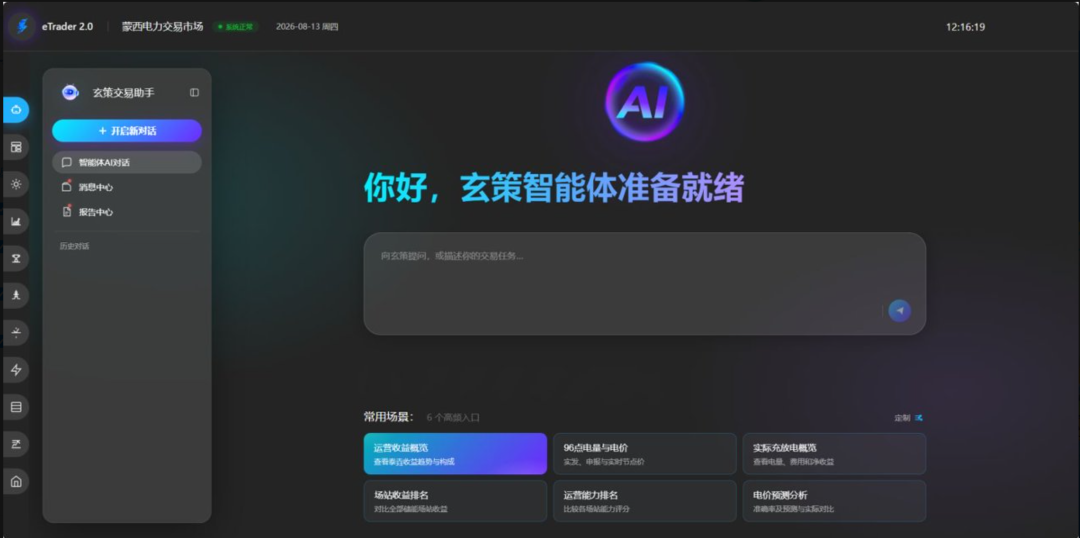
Relying on JDEnergy’s eTrader power trading intelligent operation platform, the system automatically generates multiple bidding strategies for the next-day market and provides AI-recommended solutions. It captures intraday peak-valley price fluctuations, monitors market supply-demand conditions and grid constraints in real time, and assists decision-making to reduce trading risks.
With these capabilities, the Taiyaoxin Energy Storage Power Station has maintained a leading position in regional revenue performance, ranking among the top 10% in the region.
The Industrial Value of “Building-Block-Style Deployment”
Beyond the data itself, the deeper significance of the Dongkou project lies in the fact that it represents the first large-scale application of JDEnergy’s string-based prefabricated cabin Galaxy-1 in a GWh-level source-grid-side independent energy storage project.
As one of China’s earliest providers of string-based new energy storage systems, JDEnergy is the pioneer of distributed intelligent energy blocks and the world’s first company to apply distributed intelligent energy blocks in hundred-MWh-scale energy storage projects. Since its establishment, JDEnergy has focused on the string-based technology route, continuously improving its product portfolio from distributed intelligent energy blocks to string-based energy storage prefabricated cabins. Its application boundaries have expanded from user-side and source-grid-side scenarios to integrated solar-storage-charging applications. By the end of 2025, JDEnergy had delivered more than 2,000 application scenarios.
These accumulated capabilities have become JDEnergy’s strongest foundation as the source-grid-side energy storage market transitions from “policy-driven” to “market-driven” over the past two years. As the industry raises higher requirements for system safety, efficiency, availability, and lifecycle profitability, JDEnergy’s long-term focus on string-based architecture aligns precisely with market demands.
The Dongkou project, with 400 Galaxy-1 units, once again demonstrates that string-based energy storage can evolve from a “specialized solution for small-scale scenarios” into a mainstream solution deployed at the core of the power grid. The significance of this “building-block-style deployment” lies not only in fully leveraging the advantages of JDEnergy’s energy storage systems—including high availability, high efficiency, and high uptime—but also in reducing lifecycle electricity costs through significantly shorter project delivery cycles.
Furthermore, the standardized prefabricated cabin solution enables strong replication across different sites, climates, and grid standards. The same Galaxy-1 system can be deployed both in the deserts of Inner Mongolia and in industrial parks along coastal regions.
In short, the Dongkou project comprehensively validates JDEnergy’s capabilities across the entire value chain, including supply chain management, intelligent manufacturing, engineering delivery, and intelligent operation. Through integrated hardware and software technology advantages, JDEnergy not only improves regional renewable energy consumption capacity but also maximizes lifecycle project returns, achieving a win-win outcome between strategic value and economic value.