A 3-Year Review of Independent Energy Storage in Ningxia: String Energy Storage Leads the Value Track of Independent Energy Storage

In December 2022, 10 independent energy storage power stations in Ningxia were connected to the grid and put into operation almost simultaneously. They share similar geographical locations, elevations, sunshine hours and temperature differences, and cover the mainstream technical routes at that time: centralized energy storage solutions and string energy storage solutions.
These 10 independent energy storage stations have inadvertently formed an almost ideal "test field for energy storage technology comparison".
Today, 41 months later, combined with the actual operational data, an unavoidable question arises: under identical external conditions, how large is the real revenue gap between power stations adopting different technical routes? This article draws conclusions without preset biases. Based on 41 consecutive months of actual operating data from the 10 stations, it extracts key indicators of the latest 17 consecutive months for comparative analysis, and further explores the technical logic behind data discrepancies.
Taking the Lead in Large-Scale Rollout: Ningxia’s Independent Energy Storage, Revenue Models Drive Technical Innovation
Ningxia is a major province for wind and solar power generation in China. Data from State Grid Ningxia Electric Power Economic Research Institute shows that by the end of 2025, Ningxia’s new energy installed capacity reached 57.32 GW, accounting for 58% of the total installed capacity (98.83 GW), making new energy the primary power source.
The rapid growth of new energy has created an urgent demand for regulatory resources from the power grid, accelerating the construction of energy storage facilities. By the end of 2025, the filed energy storage capacity in Ningxia exceeded 8.8 GW (mainly 2-hour duration); energy storage projects with approved grid connection schemes hit 3.5 GW; and the grid-connected energy storage capacity reached 7.63 GW / 15.26 GWh, equivalent to 13.3% of new energy installed capacity.
Large-scale deployed energy storage facilities play a vital role in facilitating new energy consumption. In 2025, energy storage boosted power generation from new energy sources by 3.482 billion kWh, lifting utilization rate by 4.18 percentage points to 94.46%, ranking first in Northwest China for five consecutive years. As new energy continues to expand, the growth potential of energy storage in Ningxia remains immense.
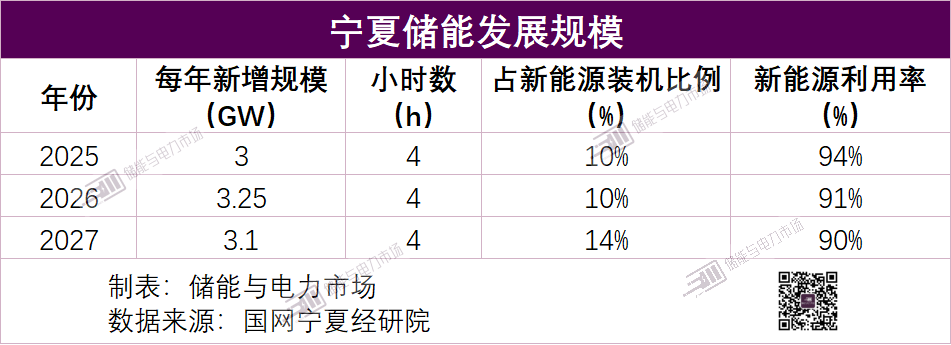
Alongside the large-scale deployment of energy storage, rapidly adjusted market mechanisms in Ningxia have brought dramatic changes to energy storage revenue models.
Year 2022
The shared energy storage model marked the breakthrough of independent energy storage in Ningxia. After establishing the market entity status of independent energy storage, a revenue model of "capacity leasing + peak-shaving ancillary service compensation" was formed. In this stage, capacity leasing prices were attractive, peak-shaving compensation stood at a high level of 0.6 RMB/kWh, and charging/discharging electricity prices broke even. The prominent policy dividends directly fueled the rapid development of independent energy storage in Ningxia.
Late 2024 to 2025
With adjustments to national power ancillary service pricing mechanisms and the advancement of power market construction, the profit model for Ningxia’s independent energy storage shifted to "capacity leasing + medium-and-long-term power market price spread revenue + peak-shaving ancillary service compensation". During this period, capacity leasing prices dropped sharply to approximately 50 RMB/kW·year, peak-shaving ancillary service compensation fell to 0.2595 RMB/kWh, and price spread revenue from the medium-and-long-term power market gradually became the core factor determining profitability. Policy support weakened, and market-oriented profit generation became increasingly critical.
Late 2025 to Present
The construction of Ningxia’s power market has accelerated comprehensively. In September 2025, consultation was launched on energy storage capacity tariffs, specifying that independent energy storage would implement a capacity compensation standard of 165 RMB/kW·year starting from 2026. In October of the same year, Ningxia’s power spot market entered continuous settlement trial operation. In 2026, multiple rules covering the medium-and-long-term market, spot market and frequency regulation ancillary service market were revised one after another, evolving the energy storage revenue model into "capacity compensation + spot market price spread revenue + frequency regulation ancillary service compensation". The era of generating profits fully through market transactions has officially arrived.
Data of energy storage stations participating in power trading has become complete and traceable, with revenue components clear and quantifiable. The core drivers for energy storage stations to boost revenue and maximize asset value include: sustaining long-term capacity reliability to secure full capacity compensation; maximizing discharged power volume to guarantee sufficient energy revenue; responding swiftly to grid demands to deliver stable ancillary services; minimizing unplanned outages to maintain high online rates and fully participate in market transactions.
Energy storage investors, system integrators and operators have clearly recognized the above issues. Beyond competition over upfront capital expenditure, they are paying growing attention to how station quality impacts profitability. Ningxia’s energy storage development logic is shifting from competing on initial construction costs to competing on real full-lifecycle revenue.
Energy storage equipment procurement and power station construction are no longer one-time capital outlays, but revenue carriers spanning a 10–15 year full lifecycle. Annual gaps in energy output, operation and maintenance costs and battery degradation rates stemming from different technical routes will accumulate over time, creating revenue gaps valued at tens of millions of RMB.
The first batch of 10 hundred-megawatt independent energy storage clusters in Ningxia, supported by real operational data, intuitively demonstrates the real revenue gaps between different technical routes, providing objective, quantifiable data references for industry technology selection.
Head-to-Head Competition: 17 Months of Actual Operational Data from Ningxia Proves String Energy Storage Stations Lead in All Dimensions
In December 2022, 10 independent energy storage stations including Tongli No.2 Energy Storage Station adopting the string technical route were connected to the grid and commissioned simultaneously, with a total installed capacity exceeding 1 GW / 2 GWh. (Figure: Tongli No.2 Energy Storage Station)
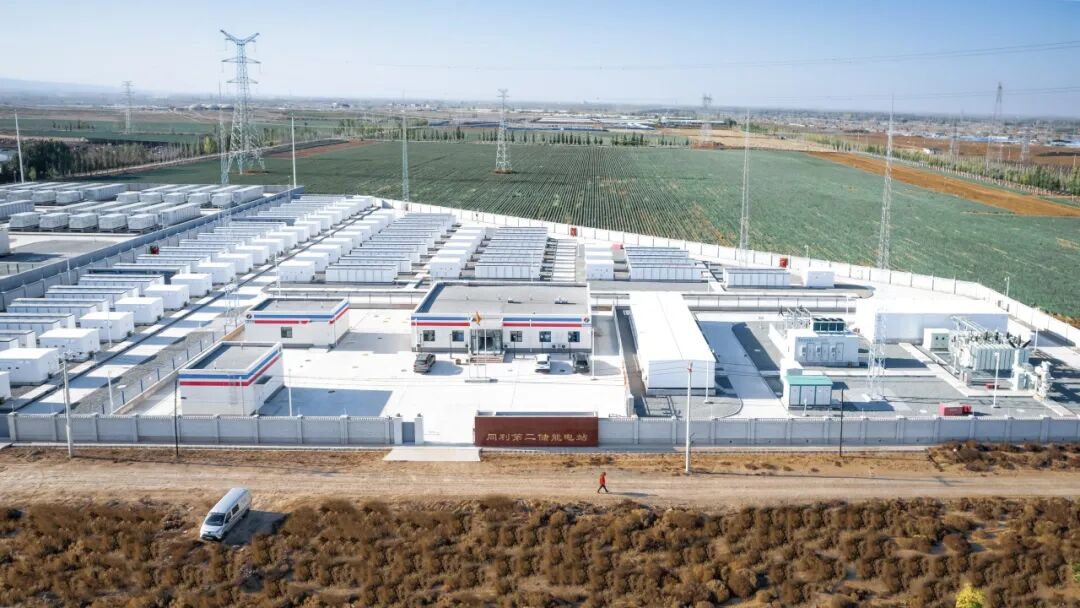
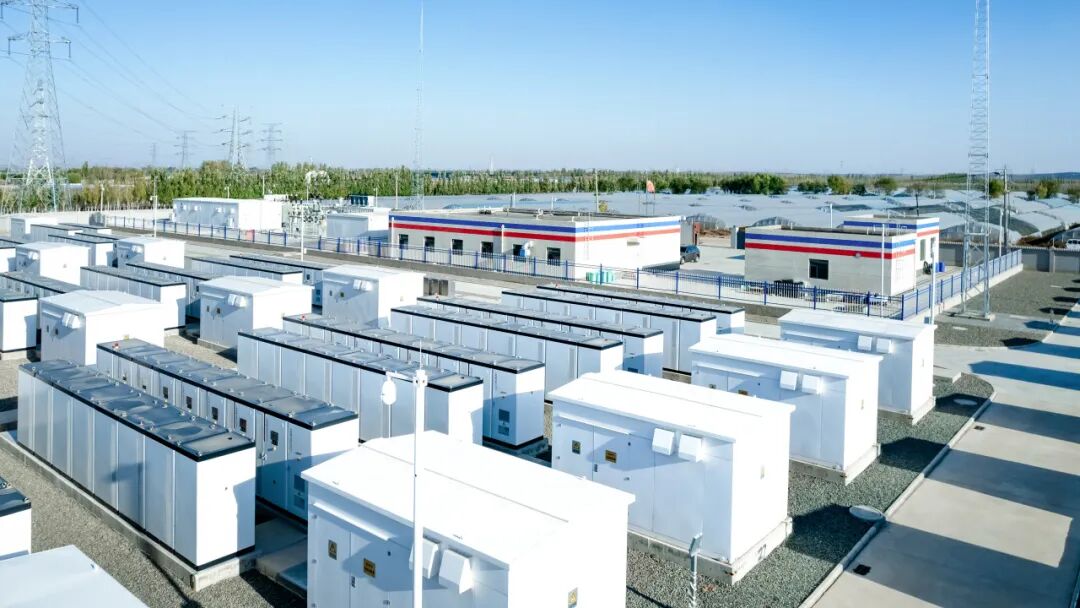
These stations were built by multiple mainstream domestic system integrators. Their uniform scale, commissioning timeline, grid connection and dispatching conditions together form a relatively fair comparison test field:
- Simultaneous grid connection: all stations completed grid access in December 2022;
- Uniform scale: all are hundred-megawatt independent energy storage stations (Note: for consistent comparison, all station capacities are converted to 100 MWh for data analysis);
- Consistent operating conditions: all located in the wind-solar belt of northern Ningxia, with nearly identical elevation, sunshine hours and temperature differences, and equal grid dispatching orders, spot trading rules and capacity compensation assessment standards. The biggest variable lies in the selection of PCS and system architecture: Tongli No.2 Energy Storage Station adopts a string solution, while the rest deploy traditional centralized PCS plus container schemes. This unbiased test field serves as a verification platform for the two major technical routes: centralized and string energy storage.
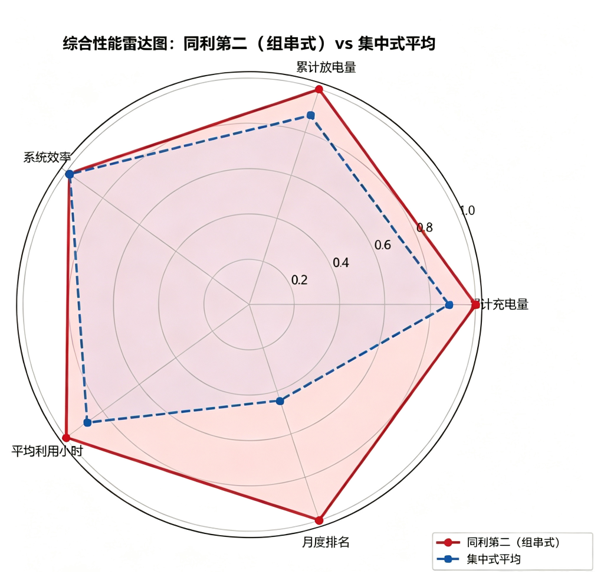
To eliminate interference from early-stage equipment commissioning and changing grid rules, the latest 17 consecutive months (January 2025 – May 2026) are selected as the core observation period from the full 41-month operation cycle. Actual operational data shows that string energy storage solutions outperform centralized alternatives across all core indicators including cumulative charging volume, cumulative discharging volume, system equivalent availability factor and average utilization hours, with particularly prominent advantages in cumulative charging and discharging volumes. (Comprehensive Performance Radar Chart: Tongli No.2 (String) vs. Average of 9 Centralized Stations)
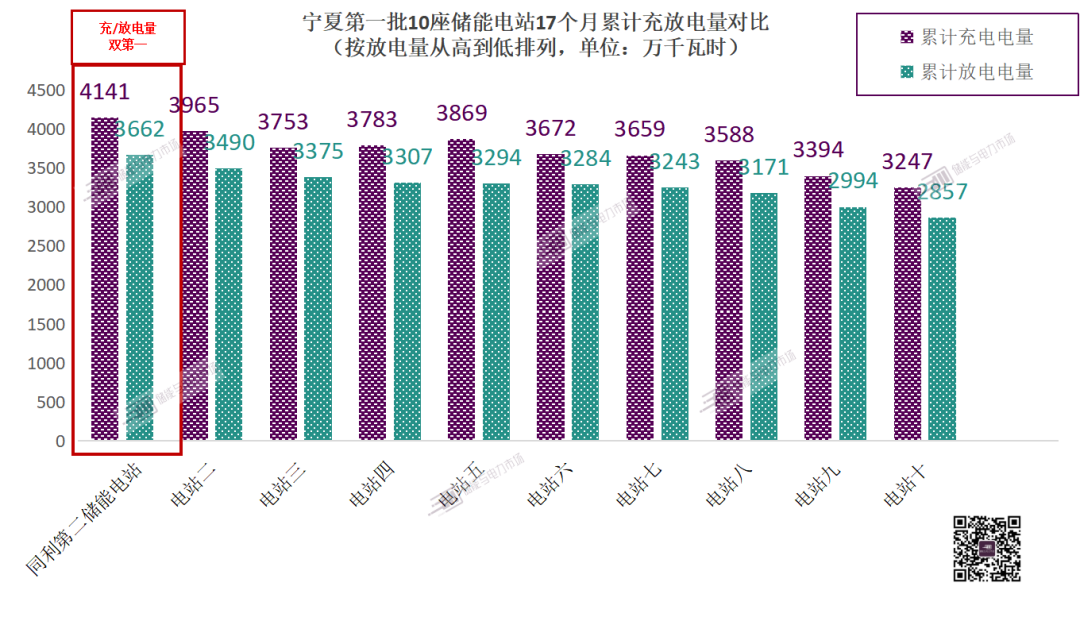
1. Tops Both Charging and Discharging Volume, Sustains Stable Leading Performance Without Downturns
Statistics from the 17-month period show that Tongli No.2 Energy Storage Station ranks first among all 10 stations in both total charging volume and total discharging volume. By contrast, a centralized energy storage station at the same geographical location ranks 7th in total charging volume and 8th in total discharging volume. The stark gap between different technical routes at identical sites is self-evident.
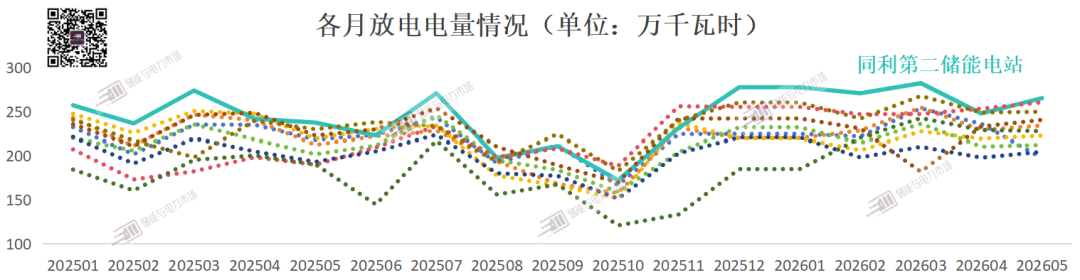
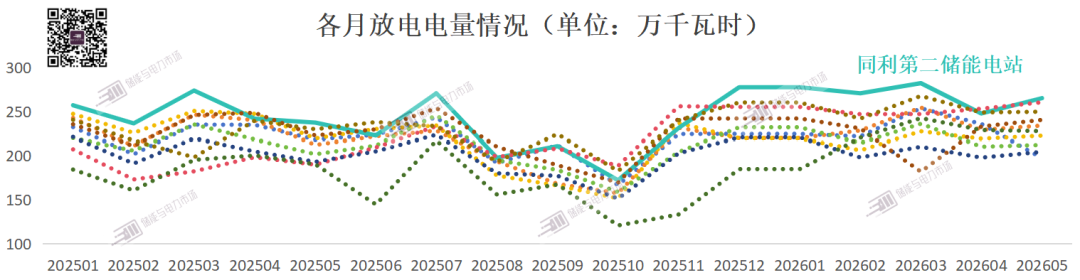
Monthly data curves further validate Tongli No.2’s outstanding stability. Apart from normal fluctuations following systemic trends, its monthly charging and discharging volumes maintain a steady upward trend with no sharp declines or monthly performance drops, delivering stable and controllable long-term power output. In comparison, centralized stations exhibit far more significant monthly volatility with wider fluctuation ranges.
2. Leads Operational Efficiency Every Month, Tops Utilization Hours
Throughout the 17 consecutive months of operation, the grid-side operational efficiency of Tongli No.2 Energy Storage Station consistently stays at a high level of around 89%, firmly within the top tier of the 10 stations. Its cumulative utilization hours hit 1,768, ranking No.1 across all facilities. On a monthly basis, it claimed the top utilization hour position in 8 out of 17 months, outperforming other stations by a notable margin.
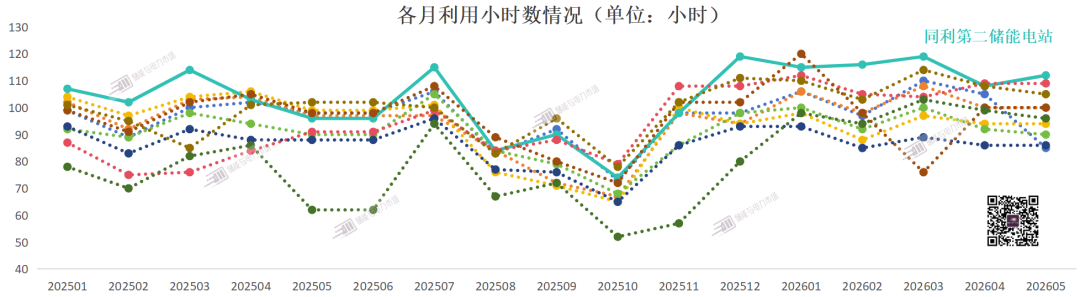
3. Generates an Extra 4.91 Million kWh of Discharged Power in Only 17 Months, Translating to Tangible Economic Returns
Higher efficiency and longer utilization hours directly convert to larger charging and discharging volumes, which translate to tangible operational profits for project owners. Within just 17 months, Tongli No.2 Energy Storage Station discharged nearly 4.91 million kWh more power than the 8th-ranked centralized station at the same location. Combined with full capacity compensation secured via high availability, plus steady ancillary service revenue from frequency regulation participation, the overall revenue gap widens further.
Architectural Breakthrough: Underlying Technical Logic Behind String Solutions Outperforming Centralized Alternatives
The gaps in efficiency, utilization hours and power output observed across 17 months of real operation in Ningxia are not short-term discrepancies caused by equipment commissioning or operation and maintenance management, but inherent performance divides determined by the underlying topological design of centralized and string architectures.
Traditional centralized energy storage adopts a multi-cluster parallel structure, inherently suffering from the wooden barrel effect. Dozens of battery clusters converge directly to a single high-power centralized PCS for unified control, sharing the same DC bus and power conversion unit. After long-term cycling, inconsistencies emerge in battery capacity and internal resistance, forcing the overall usable capacity of the entire system to be limited by the weakest cluster. Meanwhile, voltage and internal resistance gaps between clusters trigger continuous DC circulation losses, accelerating cell aging and worsening consistency issues. A fault in any battery cluster, convergence cabinet or centralized PCS requires full system shutdown for maintenance, pushing up O&M costs and lowering the overall online rate of the project.
In contrast, Tongli No.2 Energy Storage Station adopts the eBlock string energy storage solution from JDEnergy, which restructures the above architecture from the fundamental logic. As the pioneer of the string technical route, JDEnergy is also the world’s first enterprise to successfully deploy distributed compact energy storage cabinets in hundred-MWh grid-side energy storage projects. The core 3S integrated system deployed in the station’s eBlock products is fully self-developed by JDEnergy, delivering a technical foundation for refined, intelligent control of energy storage systems, while the string architecture serves as the physical carrier to maximize the performance of the 3S integration.
Specifically, the string energy storage solution breaks the system down into independent energy blocks, each equipped with built-in BMS, PCS, thermal management and safety systems. These blocks operate independently and connect in modular parallel with full decoupling, fundamentally eliminating the wooden barrel effect and circulation losses plaguing centralized schemes. Faced with Ningxia’s power market, especially the stringent requirements for response speed and regulation precision from frequency regulation ancillary services, this "decentralized" architectural design delivers natural advantages: independent control of each cluster with millisecond-level response, significantly boosting the station’s overall revenue-generating capacity. It is this difference in underlying logic that drives the clear performance divergence observed in real operation, translating architectural advantages into quantifiable performance and economic benefits.
Advantage 1: Superior Depth of Discharge (DOD) – Full Battery Capacity Utilization Maximizes Arbitrage Windows
Under this solution, each independent energy block cabinet is equipped with a dedicated string PCS, allowing battery clusters to charge and discharge without mutual interference. The charge-discharge range can be dynamically adjusted according to each cluster’s health status, enabling operation across a full 0–100% DOD range per cluster. Compared with centralized schemes, string technology delivers an inherent 5%–10% wider DOD operating window. With identical installed capacity, more power can be discharged per charge-discharge cycle, directly expanding arbitrage margins in the spot market.
Advantage 2: Exceptional Equipment Availability – 99.9% Ultra-High Online Rate Eliminates Revenue Downtime
A single point of failure in centralized systems triggers full station shutdown, with monthly availability rates generally below 98%. The string solution enables millisecond-level island isolation of faulty units; while defective cabinets are taken offline for maintenance, over 99% of the remaining capacity continues to participate in grid dispatching, spot trading and frequency regulation services. Over the 17-month operational period, Tongli No.2 Energy Storage Station maintained an annual online rate exceeding 99.9%, adding hundreds of extra hours of effective charge-discharge windows every year. It fully captures every peak-valley price arbitrage opportunity, meets capacity compensation assessment standards and reduces risks of subsidy deductions.
Advantage 3: Higher O&M Efficiency – Precise Fault Location Without Full-Station Shutdown for Repairs
Centralized O&M follows the logic of "one fault halts a large section", requiring full inspection of battery clusters and PCS units to locate malfunctions. The modular eBlock design allows online replacement of single faulty units without station shutdown, with faults pinpointed at cabinet level. O&M downtime is shortened from days to hours. The No.1 ranking of the string energy storage station in cumulative charging and discharging volumes over 17 months stands as the most tangible proof of its superior availability.
Advantage 4: Long-Term Stability – Circulation Suppression Slows Battery Degradation
DC circulation is the primary driver of accelerated battery aging. After three years of operation, centralized stations see widening internal resistance gaps between clusters and year-on-year declines in power output. The AC-side parallel topology of string solutions completely eliminates DC circulation. Independent thermal management per cabinet restricts intra-cluster temperature differences to within 3°C, effectively slowing cell degradation, significantly extending battery cycle life and drastically cutting large capital expenditures for cell replacement in the mid-to-late operational phase.
Translated Architectural Advantages: Full-Lifecycle Revenue Creates a Generational Performance Gap
Centralized schemes only hold a minor upfront cost advantage in equipment procurement. However, starting from the day of grid connection, the string architecture’s strengths in efficiency, stability and O&M continuously generate incremental revenue while lowering long-term depreciation, maintenance and replacement costs. The power output gap observed in the short 17-month operation period expands into a tens-of-millions-RMB gap in return on investment over the full 10–15 year lifecycle.
String Solutions Fully Adapt to Future Commercial Profit Demands of Independent Energy Storage
The trend is not limited to Ningxia. Amid nationwide power market reforms, independent energy storage revenue models are converging toward a diversified combination of "energy market revenue + capacity tariff compensation + ancillary service (frequency regulation) market revenue". Among these streams, energy market income typically accounts for over 50% of total revenue, making it the most critical profit source. Higher efficiency, longer utilization hours, extended online time and larger charge-discharge volumes grant energy storage stations greater flexibility in operational strategies and higher market returns.
While traditional centralized schemes appear to require lower upfront investment, they simultaneously reduce achievable DOD, lower availability rates and raise O&M expenses, ultimately pushing up the project’s overall levelized cost of electricity (LCOE). Through architectural innovation, string solutions optimize core performance indicators, delivering "a slight premium in upfront costs offset by excess long-term revenue". Their full-lifecycle LCOE is substantially lower than that of centralized alternatives.
In the future, the energy storage industry will fully abandon the extensive "construction-first, operation-after" model and enter an era of refined profit management:
- Grid dispatching authorities will tighten assessment standards for energy storage output stability, response speed and annual online duration. Stations with low availability will gradually lose eligibility for frequency regulation dispatching, with heavier deductions applied to capacity subsidies;
- Fluctuations in spot market price spreads will become normalized; only maximizing daily charge-discharge power volume can mitigate revenue risks caused by volatile market prices;
- Investors will impose stricter requirements on refined full-lifecycle station management, digital O&M and asset residual value control.
The core strengths of string energy storage — high utilization rate, exceptional stability and simplified maintenance — will consistently help operators amplify comprehensive revenue in multi-market trading environments, while mitigating operational risks stemming from policy assessments, equipment faults and battery degradation. For energy storage investors facing squeezed internal rates of return (IRR), string solutions are no longer an optional upgrade, but a mandatory selection to secure the bottom line of project profitability.
Data speaks for itself. Three years of practical evidence from Ningxia has delivered a clear conclusion: on the value track of independent energy storage, string energy storage has become the preferred technical route and will eventually emerge as the mainstream choice for large-scale energy storage facilities.